Tuesday, 17 March 2015

TBS: style guide

When making the decision on the style we had all the artists and myself go away separately and draw the same character from Banner Saga in our styles and in a style that we would like to see in the game. Mine was in my style but with extra colouring choices. Eventually we decided on my basic style with just cell colour and some cell shading to make it pop out from the painted backgrounds our background artist was making.

We were inspired by many games and art styles, some artists made a mood board and I made a mood board on colour-schemes.

I worked on redesigning the already existing designs into the style guide and photoshopped designs for how the game would viuablly look. I animated important parts to show how the animations would function and focused on the designs that would be included, there would be 3 different art styles, one for speaking-sprites (the most detailed ones), one simpler version of that in the battle screen, and a very simplified version for the grid screen that would represent the characters being a lot smaller.


I made designs for talking sprites


Examples of the grid animations using various background to make sure it's compatible.

Example of the battle screen

I then drafted out instructions and details with the image examples when writing up the style guide.

I showed examples of the anatomy style and detailed how to recreate it for the other artists.


ANIMATION: diving

I spent a lot of time and effort on this animation however I feel like I spent too much time on minor details and not on the main-subject. I should have shown more of the diving than the gloss and extra details. I started with a basic story board.


I drew out the secondary character's animation making sure it would be an even number because I knew the final animation would have 20 frames. I made sure it looped then I started on the background. Once the background was done along with the animated parts of the background (the diving board) I drew in the keyframes for the main character and animated her by adding in the tweens. I drew in the splash animation after. I lined and coloured them at the same time as drawing them as I had added such details in the story board earlier. I had planned out the main character's design before drawing so it would be consistent. I made minor changed to the animation from the story board but I added in enough detail to make a mostly rough key-frame animation from it,


ANIMATION: walking forward

I found this assignment very easy as for the main-game project I was already practicing on making animations of people walking forward. I did not have the same elasticity and freedom in that assignment and since the characters were asymmetrical I coudln't do it as fast or easily as I wanted.

Keyframes I was working on before this assignment of walking-forward (and backwards) animations for our game project.


I drew out the keyframes of the piece and filled in the tweens and then flipped it and matched up the legs so the animation would loop walking forward. I wanted to give the person a bounce in their step and a jolly look with swinging arms.

Friday, 13 March 2015

TBS: Races P.3

Once I had the synopsis of the race written out and defined I started plotting out the basic visual design. I focused on elements that would be visible and communicated them through image; colour, clothing and the masks were important. I left the form, anatomy and over all shape of the Palai-Plai for later when I would design the naked anatomy.  wanted to get the basic design of their clothing on paper first, I would redesign these to fit the new anatomy once it was finished.


I started with designs for the mask and where the feathers would be for decoration on most costumes. I started off with more details and cut back the details later for the sake of the animations and to keep the designs aesthetically appealing without clustered buzzing designs. 

I jotted in details I wanted for the body like large arms that looked like feather-less wings, claw like feet, and hashed out the general colour schemes. I wanted it to be bright, vibrant and powerful. I added extra details into the clothed design.

I drew out the same design in detail putting it into a pose to see if the design would work more in-action. I knew I would make changes to the anatomy again later but I wanted to put a general theme to it. I added more details to this than I should have and it would help me flesh out the extent of the clothing's details for the final design. I wanted it to have a lot going on due to their bold and arogant culture but I also wanted to keep it aesthetically pleasing with a nice form that would not be clouded with too much detail and as a result might loose it's silhouette.


For the final design of the Palai-Plai I worked on a mood board of the lizards I would be using as inspiration.

"I chose the Monitor because they are the biggest group of lizards (aside the crocodile family) and also because recent research has shown they have similar breathing patterns to birds. They come in a variety, I think they have a unique look to them, especially the legs and movement. The Nile, Blue Spotted, and Ornate Monitor will the the 3 main examples for this work. Nile Monitors are aggressive enough to suit the race. I also did research into the first discovered species of bird and dinosaurs with feathers to relate the clothing design to the lore."

Using the mood board I made, I drew out basic designs of the form, shape, and anatomy. 


Originally I wanted for the captain and unit types to be coded by bird names that suited them but I felt it would confuse the player. I tested colour schemes and patterns on these sketches based on the Monitor's patterns & colours I made both a bright version and a de-saturated version to fit the plain design for the Palai-Plai in contrast to the brightly coloured clothing they would be wearing. I made each of the 3 designs have a completely different anatomy and silhouette but with overreaching themes such as the beak, arms and legs. Each were based on slightly different lizards. I decided that the Tactician, Healer(later), were female and the Bruiser and Commander (later scout) were male. I changed their designs slightly in the final to fit their new roles once the statistics were planned out and merged the designs of the Tactician and Bruiser's main anatomy but gave them vastly different clothing. 
I sketched out clothing designed on top
Then I drew out turn sheets keeping the proportions more accurately drawing them naked and deciding on their skin colours and patterns, then adding clothing. I reused clothing designs from my earlier conceptualization stage of the Palai-Plai for the Tactician who had the strongest design as they would be the playable character. They would be the one who would also reveal their face in the plot so I drew up two versions of it. I wanted them to be a combination of bulky and curvy. All the designs would show a bit of flesh except for the Tactician who showed the least as they would have their face showing later. This gave a good ratio of skin to costume. I felt the skin had to be shown because the anatomy of the characters was completely made up and players would not know the form otherwise, especially with the feathers hiding the figure. I drew up the character's feather designs separate for reference in the turn sheet. I made the costumes for each reflect their need for movement and their armour. I used more blockier anatomy for characters who were muscular and more rounded ones for weaker characters.


I brainstormed colour scheme options for the characters before picking. 


Thursday, 12 March 2015

TBS: Development P.2

As I was invested in this and had a much larger basis for plot behind it as well as knowing we were very unlikely to start the conceptualisation stage again after loosing this much time on it I felt I had more time to work on the actual designs. I worked on various cocnept art that worked on hashing out details I wanted to include but not on the overall form or silhouette of the race's anatomy. I knew when I would design the final design I would have to focus on the anatomy on it's own and put the clotting on-hold for later, but to visualise the concept I needed to show what would be visible in-game and what would be unambiguous to players as the form of the Palai-Plai would be less obvious due to the race's laws on showing the face.
Once we had all independently developed our races we collaborated on race-relations and overall plot. We scaled down the game so that the plot followed the Grûk who instead of being invaded by all races were invaded by the Ashœri, (a shadow-like hive mind race which was kicked out of their home a giant tree by the Realta a light-based star-like race) and were forced to retreat from their home-land and were forced to travel and invade other lands, find help from some other races, and win back their home, slowly uncovering world history, lore and plot while travelling, recruiting some members of other races so they would still be playable, and have the mechanics still be in-game. We created a universe for the races to live and one of the artists was assigned to background and over world art, while myself and all the artists worked on concept art for the races, working on our own and on other races. Eventually the plot was scaled down again so that we would only be developing the tutorial level which had 3 stages and focused on solely the Ashœri v. Grûk battle.
I contributed ideas to the mechanics that would give us a unique selling point among Turn-Based-Strategy games. I prompted that we could have two screens, a grid screen where the "Captains" for each "unit" is only visible. You can put the characters into position and plan moves from here, as well as strategies passive and hidden abilities which varied from race to race; within each race would be 4 different types of captain with slightly different skill set but still following the same overall theme (ex: Anathir are a mostly ranged race but have different types of ranged abilities.), once you are in position on the grid you can attack. Attacking will take you to a battle screen where you see the entirety of the squad your Captain leads. You pick of the 3 remaining aggressive and visible abilities that the captain owns unique to how their squad operates and attack using that. We play tested these ideas with a board game as our programmer was still absent and used play-testing to come up with abilities and attack that a captain could use such as 'Backstab' for the Ashœri. I had the idea that the "Hit Points" be represented by units/soldiers in the squad for the captain and have health = number of remaining soldiers, once it hits 0 then the Captain is dead and that unit is wiped out. The soldiers and units would be visible by the battle screen.

An animated video showing the design conceptualisation of gird & battle screen mechanics. At the time we were considering working on a hex-grid. We didn't have any final designs for the characters so we showed it in silhouette. 


Despite the game being scaled down we wanted all the statistics figured out so they complimented and contrasted each other if we found time to include them. The head artist/designer for unit abilities helped organise the mathematics of all the statistics for all units and how their abilities would work. Everyone helped with the concept of a race's speciality on the field; Ashœri being more stealth based had abilities like back stab that worked on the grid, and the Grûk would be more melee based. I had few options to come up with for mine but I wanted mine to be tactic-based and make them similar to a support class but one that could support themselves too if planned out accordingly. I planned that they would gain abilities from formations (playing on their bird-theme) on the grid that would give them different stat-changes and supports depending how they were positioned on on the grid in relation to each other. I knew this would later need play testing to fine-tune. I made it so their default statistics were mostly low as a race so their ability wouldn't make them over powered but also would make the player want to use them. I imagine they would be a race used by more intermediate players on harder levels as they would offer huge advantages that could not be offered otherwise. This skill is a mainly passive ability for the Tactician captain that would be the one recruited, and made other captains be more formidable on their own when they are played as enemies to the player, and I made one of them a 'healer class'. The healer would work in a more 'blood magic' healing type of way if we're speaking by the way they work in-game. Since the game operates by health being literal soldiers I made it so the 'healer' has a huge number of HP (soldiers) but has no offencive attacks and literally works as a reinforcement pack that can send more soldiers to units that are hurt, at loss of HP (soldiers) of their own, but having a huge armour/defence rating makes it harder to get rid of them, though they cannot attack themselves. If we had a more reliable programmer I would have collaborated more with him and made more complex conditions for this: the units that are added by the healer would slightly lower the statistics of the group as they are less refined fighters (new recruits even). I designed the Palai-Plai race to be more complex and tactful, more likely to be difficult than the basic units offered earlier as the way the designers had planned out the level order the Palai-Plai would come in near the end of the campaign with only two more enemies left. The original Ashœri enemy would be the next level and then the god-like Realta. The Ashœri would be harder despite being on the first level because the designers have planned with the writer that the Ashœri are to be undefinable on the tutorial, a level you're meant to loose, as main characters die in-canon and to give the player an emotional investment in reclaiming their home.
The abilities and statistics after refinement from collaboration with the designer working on attributes. All following an over-all theme but being unique. The concept was simplified in application due to having issues with our absent programmer, we needed to scale down these things.

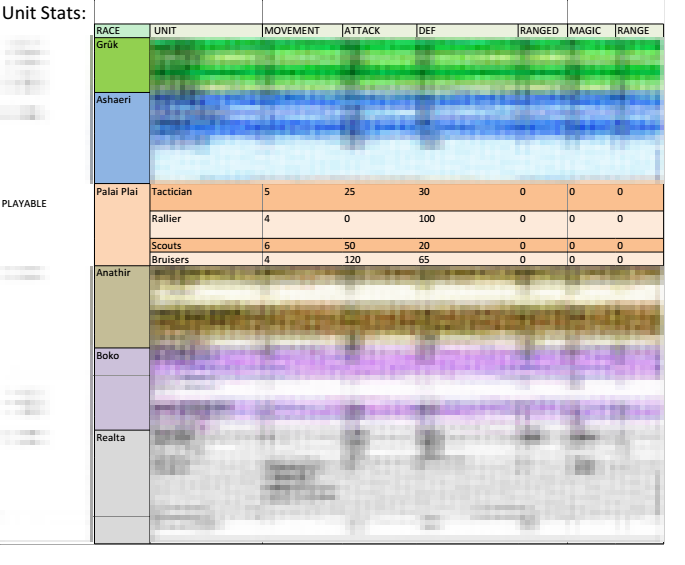
The basic statistics for the Palai-Plai units.

More Palai-Plai statistics.


TBS: Development P.1

Sadly when we went back to the drawing board on that Friday we were missing two members; both turned out to be frequently absent. In hindsight it might have been possible to have avoided ones later absences if they had been in on the weeks of conceptualisation at all as now they feel left out, and with our lecturer's advice are not 100% on the game, however there was nothing we could do at the time about someone who was absent 90% of the time and it would have been unfair on all of use to backtrack on the one concept those of us who attended every day could finally contribute to fully because of one team member who wouldn't come in, contact us, or pull their weight, no matter how vital their role may have been.
To come up with our next concept I was inspired by one of the Green-lit team's presentations, Big Kid, where they had a slide on User Stories, a part of Agile that we are working under. User Stories are usually market research for what the market wants, like a questionnaire of what gamers in the genre want, however as this is a game that is unlikely to be published and one for university as well as being low on time for the overall project and having lost a month of that time on Odette we could not properly market research real User Stories and used our own personal user stories. Like Big Kid did we documented our own user stories of our favourite games & why, what we liked in games and what we wanted to make, then collage them together to make something, this was a suitable fix to the issue of always getting stumped on following a singular person's concept and made a game that we were all invested in and felt a part of, making a proper flat-hierarchy.
We had varied interests, some preferring aesthetics, some story & characters, some a mix of the two, I like most things when they are Reconstruction or deconstructions of tropes, and we found the members who preferred game play and mechanics preferred games with strategy. We decided we wanted to make a Turn-Based Strategy game with fantasy and RPG elements, with unique and developed character interactions and story, with a new spin on the fantasy strategy genre that did not follow the typical trope for fantasy races and worlds so we could create our own races and our own history and lore. I prompted at the end of the day that we should all take our time to develop and come up with our own individual races to add to the concept so we could all contribute a section of the story that had our own influence and investment into the game. We worked on it individually on the weekend. We wanted our game to have each of our own identity into the game so we would feel emotionally invested in contributing. The results were better and more diverse than we expected, and ironically we all managed to create races that followed the same elemental and anthropomorphic theme so they would easily link together and could easily spawn a story together.
A story board animation of what a scrapped idea for a cut-scene would look like at the start of the game, implying most of the plot points. 

I had a basic idea of a plot. At the start the mechanics I had thought of involved multiple (7) races that a player you'd pick from and would follow the campaign of, each one invading (and one defending) a country and claiming dominance as the goal, and in each campaign they would interact and encounter the other races at some point and fight them, each plot-line being slightly different as the order of the encounters depends on the campaign, giving an emotional link to the player that a character they might have played as on their first campaign and become attached to they would have to kill themselves in a different campaign. We also wanted each race to have different relationships to the other races depending on their history and lore, but would develop that together in meetings after we had the basics of our races.
Visualisations of the campaign routes

A visualisation of emotional plot points I had brainstormed for the scrapped plot.

Wednesday, 11 March 2015

Odette P.4

Despite the animated design being favoured by the artists and designers I tried to come up with more designs that fitted more to the sole elegant style idea, I don't regret attempting a new one even though I don't feel the design worked. A lecturer prompted that we try to solidify the concept into one theme as our blood bath and over-the-top mechanic did not work with the 'subtle elegance' theme, and if we wanted to go with that theme we would have to show that theme more visually as a whole, not in small parts of the design as it has caused us to lack a focus. As a result I had a go at designing a more subtle, elegant themed 'Odette'.


I worked on a design that would be more elegant only based but have Gothic and horror themes into it, drawing a combined inspiration of Venetian masks and Plague Doctor masks. A theme of blood-roses & rotten flowers and fruit came from Plague Doctor's having had flowers and perfumes in their helmets as they believed the smell to spread the plague, and tried to cover it. I wanted to keep with the more 'subtle' theme and have heavily implied gore and death imagery without having over-the top gore and have everything be hinted by intention in the design. I designed her with the concept of the devils and demons from the Hell of our universe all being once-living people who are now an abstract concept of their own deaths.

I animated her movement in a more basic and rushed way than I did with the last Odette design to visualise and explain parts of her design in action that I had trouble explaining in conceptualisation. This concept didn't stick as we felt the design lacked practicality in movement and focused too much on the elegant theme which did not fit in with the mechanics. I feel the design itself needed more fleshing out beyond this rough design, but I do feel the themes of the design had strengths. In a way it was slow and wouldn't fit with our game mechanic as there would be no obvious way for her to move fast & keep with the designs elements, while the core mechanics relied on fast paced 'blood bath'.
We theorised that this design could be recreated into one of the bosses the real Odette would fight and brainstormed on various ways she would be defeated. The back of the head in combination with her spider legs was one less fleshed out idea, and another was removing the mask then stabbing the lungs through the chest.

I elaborated slightly on the idea adding details and changing themes of it but could not use the same basic design effectively as it would never have the wide rage of movement or fit the bloody theme we had. I made a design with a more basic subtlety and brainstormed different heads for it including an animal one. I drafted it by making a silhouette.


Eventually the entire concept of "Odette" was scrapped as we lacked focus, which became very clear to us in our presentation to get green-lit. It also became obvious that our concept was unoriginal as it was too heavily inspired by the writer's interests in the Bayonetta series to the point that no team member could contribute originally our own ideas. We were told by the lecturers it would be best for us to start from scratch and while we were unsure at first we do feel we made the right choice by doing so.