As I was invested in this and had a much larger basis for plot behind it as well as knowing we were very unlikely to start the conceptualisation stage again after loosing this much time on it I felt I had more time to work on the actual designs. I worked on various cocnept art that worked on hashing out details I wanted to include but not on the overall form or silhouette of the race's anatomy. I knew when I would design the final design I would have to focus on the anatomy on it's own and put the clotting on-hold for later, but to visualise the concept I needed to show what would be visible in-game and what would be unambiguous to players as the form of the Palai-Plai would be less obvious due to the race's laws on showing the face.
Once we had all independently developed our races we collaborated on race-relations and overall plot. We scaled down the game so that the plot followed the Grûk who instead of being invaded by all races were invaded by the Ashœ
ri, (a shadow-like hive mind race which was kicked out of their home a giant tree by the Realta a light-based star-like race) and were forced to retreat from their home-land and were forced to travel and invade other lands, find help from some other races, and win back their home, slowly uncovering world history, lore and plot while travelling, recruiting some members of other races so they would still be playable, and have the mechanics still be in-game. We created a universe for the races to live and one of the artists was assigned to background and over world art, while myself and all the artists worked on concept art for the races, working on our own and on other races. Eventually the plot was scaled down again so that we would only be developing the tutorial level which had 3 stages and focused on solely the Ashœ
ri v. Gr
ûk battle.
I contributed ideas to the mechanics that would give us a unique selling point among Turn-Based-Strategy games. I prompted that we could have two screens, a grid screen where the "Captains" for each "unit" is only visible. You can put the characters into position and plan moves from here, as well as strategies passive and hidden abilities which varied from race to race; within each race would be 4 different types of captain with slightly different skill set but still following the same overall theme (ex: Anathir are a mostly ranged race but have different types of ranged abilities.), once you are in position on the grid you can attack. Attacking will take you to a battle screen where you see the entirety of the squad your Captain leads. You pick of the 3 remaining aggressive and visible abilities that the captain owns unique to how their squad operates and attack using that. We play tested these ideas with a board game as our programmer was still absent and used play-testing to come up with abilities and attack that a captain could use such as 'Backstab' for the Ashœri. I had the idea that the "Hit Points" be represented by units/soldiers in the squad for the captain and have health = number of remaining soldiers, once it hits 0 then the Captain is dead and that unit is wiped out. The soldiers and units would be visible by the battle screen.
 |
| An animated video showing the design conceptualisation of gird & battle screen mechanics. At the time we were considering working on a hex-grid. We didn't have any final designs for the characters so we showed it in silhouette. |
Despite the game being scaled down we wanted all the statistics figured out so they complimented and contrasted each other if we found time to include them. The head artist/designer for unit abilities helped organise the mathematics of all the statistics for all units and how their abilities would work. Everyone helped with the concept of a race's speciality on the field; Ashœri being more stealth based had abilities like back stab that worked on the grid, and the Gr
ûk would be more melee based. I had few options to come up with for mine but I wanted mine to be tactic-based and make them similar to a support class but one that could support themselves too if planned out accordingly. I planned that they would gain abilities from formations (playing on their bird-theme) on the grid that would give them different stat-changes and supports depending how they were positioned on on the grid in relation to each other. I knew this would later need play testing to fine-tune. I made it so their default statistics were mostly low as a race so their ability wouldn't make them over powered but also would make the player want to use them. I imagine they would be a race used by more intermediate players on harder levels as they would offer huge advantages that could not be offered otherwise. This skill is a mainly passive ability for the Tactician captain that would be the one recruited, and made other captains be more formidable on their own when they are played as enemies to the player, and I made one of them a 'healer class'. The healer would work in a more 'blood magic' healing type of way if we're speaking by the way they work in-game. Since the game operates by health being literal soldiers I made it so the 'healer' has a huge number of HP (soldiers) but has no offencive attacks and literally works as a reinforcement pack that can send more soldiers to units that are hurt, at loss of HP (soldiers) of their own, but having a huge armour/defence rating makes it harder to get rid of them, though they cannot attack themselves. If we had a more reliable programmer I would have collaborated more with him and made more complex conditions for this: the units that are added by the healer would slightly lower the statistics of the group as they are less refined fighters (new recruits even). I designed the Palai-Plai race to be more complex and tactful, more likely to be difficult than the basic units offered earlier as the way the designers had planned out the level order the Palai-Plai would come in near the end of the campaign with only two more enemies left. The original Ashœri enemy would be the next level and then the god-like Realta. The Ashœri would be harder despite being on the first level because the designers have planned with the writer that the Ashœri are to be undefinable on the tutorial, a level you're meant to loose, as main characters die in-canon and to give the player an emotional investment in reclaiming their home.
 |
| The abilities and statistics after refinement from collaboration with the designer working on attributes. All following an over-all theme but being unique. The concept was simplified in application due to having issues with our absent programmer, we needed to scale down these things. |
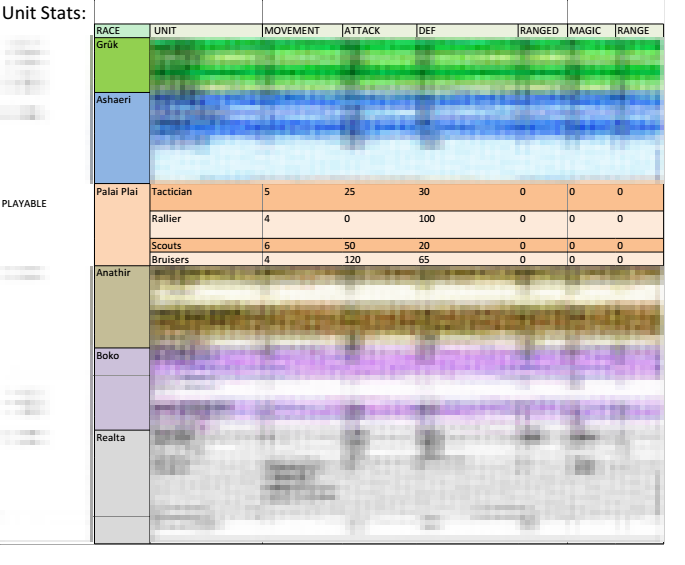 |
| The basic statistics for the Palai-Plai units. |
 |
| More Palai-Plai statistics. |


.png)
.png)


.png)


